

The rapid expansion of artificial intelligence infrastructure is typically framed as an energy problem. Data centers are projected to consume a growing share of global electricity demand: The International Energy Agency estimates they could account for 3 to 4 percent of total global consumption within this decade.
Utilities are already adjusting long-term forecasts to accommodate anticipated growth from hyperscale facilities and high-density compute clusters.
This framing captures scale. It misses behavior.
The emerging issue is not simply how much power large-scale compute systems consume, but how increasingly dense and synchronized computational workloads are beginning to alter the operating characteristics of the electrical grid itself through increasingly unpredictable demand that varies rapidly in both time and location, creating new operational challenges for grid operators.
AI’s capricious energy needs
Traditional grid planning assumes relatively predictable demand behavior. Industrial, commercial, and residential loads generally follow established profiles that can be forecast with reasonable accuracy. Even substantial demand growth has historically been manageable through reserve planning, transmission upgrades, and demand management programs.
Large-scale compute infrastructure introduces a different class of electrical load. Training—the computational task of making AI models—tends to be highly synchronized across clusters of GPUs, TPUs, and specialized accelerators operating in parallel, computationally dense, and relatively scheduled. Inference—the process of actually using those models—is generally more distributed and user-driven, making demand less predictable both in time and location. Both differ materially from traditional industrial demand profiles, though for different reasons. Unlike many conventional industrial processes, these workloads can ramp rapidly depending on model training cycles, distributed compute coordination, and workload scheduling strategies.
From the perspective of the grid, this is not simply higher demand. It is more abrupt demand. High-density compute workloads can produce substantial step-changes in electricity consumption over extremely short intervals, including rapid fluctuations occurring within milliseconds. Data center operators are already deploying mitigation technologies, including batteries, power-conditioning systems, and supercapacitors. Collectively, however, data centers’ rapid load changes can place additional stress on backup generation reserves, systems that adjust supply as demand changes, frequency-control mechanisms that maintain grid stability, and local transmission infrastructure.
Compute-related variability differs from the intermittency introduced through renewable energy integration. Wind and solar variability originate primarily on the supply side and is tied to environmental conditions. Compute-related variability emerges on the demand side, driven by workload synchronization, scheduling behavior, and computational intensity. The interaction between increasingly dynamic supply and demand conditions introduces additional uncertainty into forecasting, reserve management, congestion planning, and balancing operations.
Research organizations including the National Renewable Energy Laboratory (NREL) have emphasized the growing complexity associated with integrating highly dynamic resources into modern grid operations.
Location, location, location
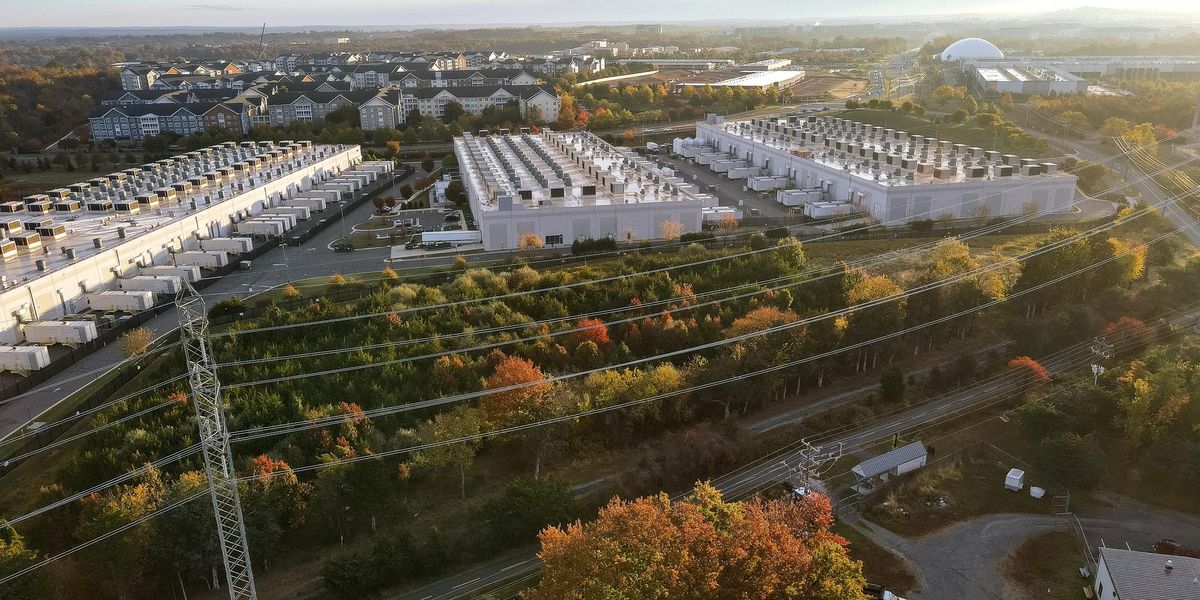
The issue becomes more significant when compute activity is geographically concentrated. Large-scale data centers tend to cluster in regions with favorable conditions such as fiber connectivity, access to markets, tax incentives, and historically low electricity costs. Northern Virginia, often referred to as “Data Center Alley,” remains the most prominent example. The region hosts the world’s largest concentration of data centers and carries a substantial share of global internet traffic.
Utilities operating in these regions have already identified data center growth as a primary driver of future load expansion. Virginia-based electricity supplier Dominion Energy, for example, has repeatedly highlighted hyperscale demand growth in its integrated resource planning documents.
 Virginia has seen one of the largest data center buildouts worldwide. Here, Amazon Web Services and iron mountain data centers dominate the landscape in Manassas, Virginia. Nathan Howard/Bloomberg/Getty Images
A sudden increase in electricity consumption within a constrained geographic area can stress substations, transmission corridors, and local balancing operations even if the broader grid maintains sufficient aggregate capacity. This creates localized reliability challenges that are not always visible through system-wide demand metrics alone.
Thermal management systems further intensify these effects. Cooling infrastructure in high-density compute facilities must respond dynamically to changing workloads. As processing intensity rises, cooling demand rises with it, often nonlinearly. This coupling between compute and thermal systems means that fluctuations in workload can propagate through multiple layers of facility power consumption simultaneously.
High-density compute clusters may also introduce power quality concerns at the local level. Large concentrations of accelerators, switching power supplies, and high-frequency compute equipment can generate harmonics and nonlinear load behavior that place additional stress on distribution infrastructure. While modern facilities incorporate mitigation technologies, the scale and concentration of next-generation compute facilities may require utilities and operators to revisit assumptions surrounding localized power conditioning, harmonics management, and infrastructure resilience. These conditions can also contribute to short-duration electrical transients that place additional stress on localized infrastructure and power-conditioning systems.
Regulations need updating
Part of the challenge is that many existing regulatory and operational frameworks were designed around relatively stable industrial demand profiles. Large rapidly fluctuating loads have historically been constrained because abrupt cycling can complicate balancing operations, increase stress on transmission equipment, and reduce predictability in system operations. High-density compute clusters do not fit neatly within those assumptions.
This creates pressure for both operational adaptation and regulatory reassessment.
Demand response mechanisms may allow certain compute workloads to be shifted or curtailed during periods of system stress. Data-center operators are exploring flexible scheduling, battery storage, and behind-the-meter generation. Grid operators, meanwhile, are evaluating planning frameworks and interconnection approaches for increasingly large flexible loads.
The Electric Reliability Counsil of Texas (ERCOT), for example, has publicly acknowledged the growing implications of large flexible loads, including data centers, for long-term grid planning and operational stability. Interconnection queues across the United States continue to expand significantly, reflecting mounting pressure on both generation and transmission infrastructure. Grid expansion timelines, however, are measured in years rather than quarters.
This creates a structural mismatch. Compute infrastructure can scale rapidly. Electrical infrastructure generally cannot.
The broader implication is that large-scale compute infrastructure is not simply another industrial load category. It represents a shift in the temporal and spatial characteristics of electricity demand itself.
Framing the issue solely in terms of aggregate energy consumption risks overlooking these second-order operational effects. Capacity expansion alone does not fully address rapid ramping behavior, synchronization, localized congestion, transient instability, reserve compression, or increasingly demanding load-following requirements.
The challenge is not just how much electricity these systems consume. It is how they are beginning to change the operating conditions of the grid itself. The call is not to slow AI development but to recognize that hyperscale computing represents a new category of electrical demand. As AI infrastructure continues to scale, planning frameworks may need to account not only for total energy consumption but also for demand volatility, synchronization effects, and geographic concentration. Grid resilience will increasingly depend on understanding how these facilities consume power, not simply how much power they consume.
From Your Site Articles
Related Articles Around the Web
More Information & Source
Original Source:
Visit Original Website
Read Full News:
Click Here to Read More
Have questions or feedback?
Contact Us








No Comment! Be the first one.