

Manifolds address a problem that mathematicians would otherwise have to deal with: A shape’s properties can change depending on the nature and dimension of the space it lives in (and how it sits in that space). For instance, lay a piece of string on a table and connect its ends without lifting it. You’ll get a simple loop. Now hold the string in the air and tie its ends together. By considering the string in three dimensions, you can pass it over and under itself before you connect the ends, creating all sorts of knots beyond the simple loop. They all represent the same one-dimensional manifold—the looped string—but they have different properties when considered in two versus three dimensions.
Mathematicians avoid such ambiguities by focusing on the manifold’s intrinsic properties. The defining property of manifolds—that at any point, they look Euclidean—is immensely helpful on that front. Because it’s possible to think about any small patch of the manifold in terms of Euclidean space, mathematicians can use traditional calculus techniques to, say, compute its area or volume, or describe movement on it.
To do this, mathematicians divide a given manifold into several overlapping patches and represent each with a “chart”—a set of some number of coordinates (equal to the manifold’s dimension) that tell you where you are on the manifold. Crucially, you also need to write down rules that describe how the coordinates of overlapping charts relate to one another. The collection of all these charts is called an atlas.
You can then use this atlas—whose charts translate smaller regions of your potentially complicated manifold into familiar Euclidean space—to measure and explore the manifold one patch at a time. If you want to understand how a function behaves on a manifold, or get a sense of its global structure, you can break the problem up into pieces, solve each piece on a different chart, in Euclidean space, and then stitch together the results from all the charts in the atlas to get the full answer you’re seeking.
Today, this approach is ubiquitous throughout math and physics.
Manifold Uses
Manifolds are crucial to our understanding of the universe, for one. In his general theory of relativity, Einstein described space-time as a four-dimensional manifold, and gravity as that manifold’s curvature. And the three-dimensional space we see around us is also a manifold — one that, as manifolds do, appears Euclidean to those of us living within it, even though we’re still trying to figure out its global shape.
Even in cases where manifolds don’t seem to be present, mathematicians and physicists try to rewrite their problems in the language of manifolds to make use of their helpful properties. “So much of physics comes down to understanding geometry,” said Jonathan Sorce, a theoretical physicist at Princeton University. “And often in surprising ways.”
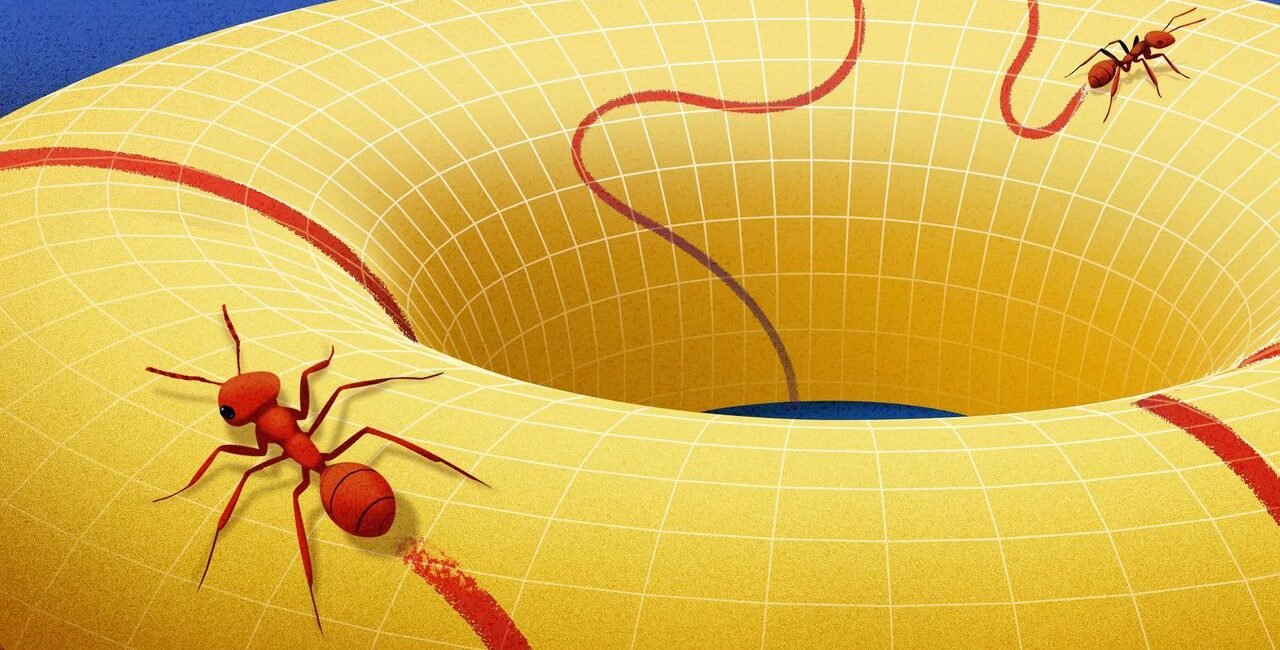
Consider a double pendulum, which consists of one pendulum hanging from the end of another. Small changes in the double pendulum’s initial conditions lead it to carve out very different trajectories through space, making its behavior hard to predict and understand. But if you represent the configuration of the pendulum with just two angles (one describing the position of each of its arms), then the space of all possible configurations looks like a doughnut, or torus—a manifold. Each point on this torus represents one possible state of the pendulum; paths on the torus represent the trajectories the pendulum might follow through space. This allows researchers to translate their physical questions about the pendulum into geometric ones, making them more intuitive and easier to solve. This is also how they study the movements of fluids, robots, quantum particles, and more.
More Information & Source
Original Source:
Visit Original Website
Read Full News:
Click Here to Read More
Have questions or feedback?
Contact Us

Other Articles

Flu Is Relentless. Crispr Might Be Able to Shut It Down





No Comment! Be the first one.