

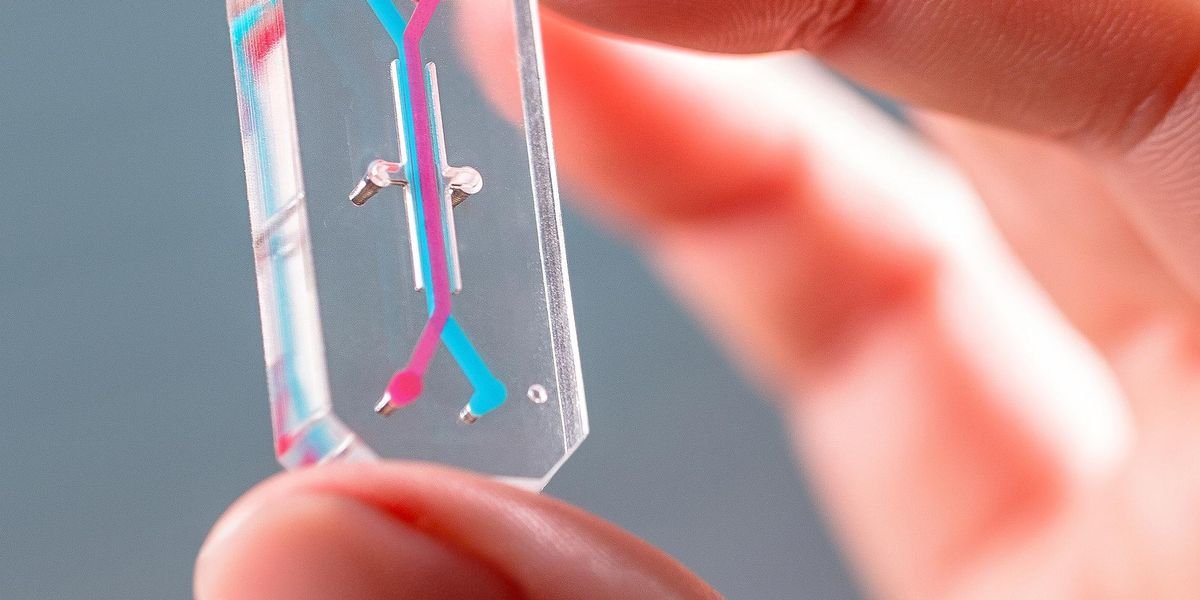
Seventeen years ago, cell biologist Donald Ingber and his colleagues at Harvard University’s Wyss Institute for Biologically Inspired Engineering submitted a paper to the journal Science describing their model human lung. It was smaller than a USB stick and made of a clear polymer slab containing narrow channels, which were lined with the type of cells that line a lung’s air sacs and blood vessels. When air was pumped through hollow chambers beside the channels, the device rhythmically expanded and contracted—it “breathed.”
This lifelike movement was a dramatic change from previous generations of lung models, which typically used static cultures of lung tissue that were unable to simulate the movements essential to lung function. When exposed to inflammatory proteins and bacteria, Ingber’s artificial lung reacted much as living lungs would. And exposure to silica nanoparticles used to model the effects of ultrafine particulates revealed that movement affected how tissues absorbed them.
 Donald Ingber led the team that developed the first human lung-on-a-chip at Harvard University’s Wyss Institute. Sam Ogden
It was a powerful proof-of-principle demonstration of a system that could be used to test drugs and other chemicals, providing a complement and even an alternative to testing in tissue cultures or in animals. Even so, the editors at Science were hesitant. They rejected the paper and suggested that Ingber’s team also run the tests in mice.
It wasn’t an unreasonable request: Harvard’s lung system was new and comparing the results it generated to results from mice would help validate it. Ingber’s team ran the suggested experiments and resubmitted their study a year later, in 2010, at which point it was published. (It has since been cited by nearly 5,400 other papers.) Still, the incident spoke to how animal models have been the default of modern biomedical research.
 An early lung-on-a-chip developed at Harvard’s Wyss Institute used microfluidic channels lined with human cells to reproduce key features of lung function. Wyss Institute at Harvard University
A recent story told by Ilka Maschmeyer, a translational toxicology researcher and executive at the German biotech company TissUse, shows how much things have changed. TissUse specializes in building organ-on-a-chip systems—the conversational name for systems like Ingber’s lung—that are used by pharmaceutical companies for research. A few months ago, says Maschmeyer, a pharmaceutical company approached TissUse after being denied permission by the U.S. Food and Drug Administration to run a clinical trial of a new drug. The problem: It had presented animal data, but the FDA wanted data from organs-on-a-chip or some comparable alternative. The standards had come full circle.
The moment spoke to a trend, perhaps even the early days of a fundamental shift, away from the use of animals in toxicology and drug development. “It’s rare still,” says Maschmeyer, “but I think it’s going to be more and more frequent.”
A host of these kinds of alternatives to experiments on animals have been developed over the years. Collectively they’re known as NAMs, an acronym that stands, depending on whom you’re talking to, for new approach methodologies, novel alternative methods, or nonanimal methods. Most NAMs have yet to be rigorously tested, but early studies suggest their potential.
As NAMs have become more sophisticated, the question of how they will be implemented has become less about their technical qualities and more about the practical next steps needed to realize their potential. Validating NAMs—standardizing the systems, conducting head-to-head comparisons with animal experiments—is an enormous challenge. Moreover, simply outperforming animal models is necessary but not sufficient. The adoption of NAMs will require changes in policy, training, and culture.
“This transition process is much more complicated than you would think,” says Thomas Hartung, a toxicologist and director of the Center for Alternatives to Animal Testing at Johns Hopkins University. “It is more about change management than it is about the technology.”
The Technologies Replacing Animal Testing
For decades, animal advocates and many scientists have criticized both the morality and usefulness of experimenting on animals. An estimated 92 percent of all drugs that enter U.S. clinical trials fail to reach the market, sometimes for business reasons but often because the drugs prove ineffective or unsafe in ways that were not predicted by animal experiments. Failure rates are even higher in drugs for heart disease, cancer, and diseases of the brain.
These statistics don’t automatically mean that a reliance on animals is to blame. Flawed study designs are a problem too, and also the sheer confounding complexity of disease. But there’s little question that animals have made poor surrogates for many conditions. And just as animal experiments may mistakenly suggest efficacy or fail to predict harm in humans, they might also erroneously suggest that drugs are ineffective or harmful when they could actually work in humans. Some researchers argue that if aspirin or acetaminophen had been discovered after the advent of modern testing requirements, they might have been abandoned.


 TissUse’s Humimic systems use microfluidic chips to culture human tissues and model interactions between organs. A researcher images tissues in a chip during an experiment [top], Humimic chips sit in a temperature-controlled unit [center], and a researcher prepares chips for use [bottom].TissUse (3)
Researchers developing NAMs have pushed these systems far beyond old-fashioned tissue cultures. The new technologies include organoids that more closely mimic the structure, composition, and function of human organs. More humanlike still are organ-on-a-chip systems; alongside Ingber’s lung-on-a-chip are brains, hearts, kidneys, and even placentas on a chip. As many as 10 such organs have been linked together, yielding multi-organ systems that promise to recapitulate many aspects of human physiology—not perfectly, but better than a mouse or a monkey would. Supporting these systems are computational simulations of organs and organisms, and also artificial intelligence tools that analyze data generated by other systems and inform future experiments in a high-powered iterative loop.
Yet even as studies piled up and some pharmaceutical companies started using NAMs in-house, the U.S. regulatory system governing drug developing and testing remained an obstacle to their wider use. NAM proponents were overjoyed, then, when in late 2022 the FDA Modernization Act 2.0 passed into law. It explicitly authorized the use of NAMs in the preclinical studies required of new drugs before they could enter human trials. Previous regulations had mandated animal testing; now the door was open to alternatives. It was a landmark moment. “That was something I didn’t expect to see in my life,” says Maschmeyer.
Although immediate in-the-lab impact was limited, the FDA’s decision was a harbinger of things to come. In 2025, the FDA pledged “to make animal studies the exception rather than the norm” for drug safety testing. Then, in September 2026, the agency followed up by issuing a rule that, if it takes effect, will replace references to “animal tests” in its drug-development regulations with the broader term “nonclinical tests.” The change makes explicit that validated alternatives such as human-cell systems, organs-on-chips, and computer models can be used when appropriate.
Also in 2025, the U.S. National Institutes of Health, the world’s largest public biomedical research funder, announced that researchers applying for grants to study animal models would also need to incorporate nonanimal research, such as real-world data or studies of NAMs. Meanwhile, the European Commission and United Kingdom have announced their own plans to phase out animal testing, and the intergovernmental Organisation for Economic Co-operation and Development updated its influential guidelines to allow for expanded use of NAMs.
NAM proponents say these shifts were essential: If regulators won’t accept NAM results, there’s less incentive to adopt them, especially for researchers already working with animals. Maschmeyer says TissUse’s clients increasingly include scientists whose research has been focused on animals. “I see, within the last year, a change,” says Maschmeyer. “It’s more people who are working with animal models who now have to also add in vitro models.” She traces it mainly to the regulatory shift—a trend Ingber calls “game-changing.”
Proving That NAMs Work
It’s not enough for regulators to say that NAMs can or should be used, though. Even more important is the regulatory apparatus dedicated to assessing how they should be used. This begins with their validation: the process by which experimental methodologies and devices are determined to be reliable and trustworthy. A prototype brain-on-a-chip designed to model a rare neurological disease might work fine in the lab that developed it—but to be validated, the system needs to work in the real world.
“You read about all the organ chips that come out of academic labs, which is great—but that’s not going to change their uptake by the FDA, because you have to get the same results anywhere in the world. It has to be a commercial product. It has to be mass-produced and meet very fine performance criteria,” says Ingber. For example, even minute variations in the hydrogels used as tissue scaffolds in organ chips can produce very different growth patterns.
 Emulate’s Organ-Chips are connected to the company’s automated culture system, which supplies the chips with nutrients and controls the flow of fluid through them. Emulate
Workflows and procedures need to be uniform, too. One obstacle to wider use of vascularized tumor-on-a-chip platforms in developing cancer therapies, for example, is the different metrics used by different research groups to characterize blood-vessel function and geometry. Experimental guidelines, workflows, checkpoints, metrics, reporting criteria: All need to be standardized in order for researchers to compare their work and collaborate across platforms. Members of Ingber’s lab coach industry researchers on how to use chips developed by Emulate, a company founded by Ingber. But even with instructions, they still need help with the finer points of tending to stem-cell cultures.
When a NAM is ready for commercial use and researchers know how to use it, the most important test—whether it provides clinical benefit—still remains. A rare-disease organ chip might be reliable, but are the biomarkers it measures actually relevant? If so, are the algorithms that extrapolate chip results to the drug’s in-body effects truly predictive?


 Microscopic images reveal the human tissues grown inside Emulate’s Organ-Chips. Bacteria, shown in magenta, interact with mucus and airway cells in a LungChip [top]; an IntestineChip develops structures resembling those that absorb nutrients in the small intestine [center]; and tiny hairlike cilia grow on cells in another LungChip, where they help move mucus and trapped particles out of the airway [bottom].Emulate (3)
Such questions have been answered for some NAMs. For example, a liver-on-a-chip system from Emulate correctly flagged about seven out of every eight drugs that had safely passed animal trials but proved toxic to human livers. A similar study was conducted by researchers from Oxford University and Janssen Pharmaceutica (later renamed Johnson & Johnson Innovative Medicine). That team showed that their computational simulations of human heart cells flagged compounds that caused a type of dangerous heart arrhythmia with 89 percent accuracy, compared to animal studies that were 75 percent accurate.
Such studies, however, are complicated and costly. Emulate’s study required 870 chips and the labor equivalent of 16 full-time employees working for 16 weeks—efforts far beyond the reach of the average lab. If the researchers wanted regulatory approval to use their chip to predict large-molecule drugs rather than the small-molecule drugs they tested, they would have needed to run another such study for that particular use. And comparable studies ostensibly need to be conducted for every commercially available NAM and every context in which they would be used—a vast undertaking. “That’s a challenge,” says Kathy Archibald, founder of Safer Medicines Trust, a United Kingdom–based group that considers animals to be poor models of human biology. “It takes too long and costs too much, and small companies can’t afford to do it.”
Ingber thinks that academic scientists need to collaborate more with industry researchers on NAMs, and that governments should fund those projects. He and other NAM proponents also stress the importance of having access to the necessary data: Without information from preclinical animal studies and human clinical trials, comparisons are difficult, but much of that data is now proprietary. Pharmaceutical companies and regulators need to share it, they say, and the FDA has called for an open-access repository of drug toxicity data. Hartung of Johns Hopkins also suggests that new animal experiments be run in parallel with NAMs, producing side-by-side comparisons.
To Christian Maass, a computational biologist at the German biotechnology company ESQlabs, NAMS are overdue for a showdown with animal models. His company makes “digital twin” systems in which data from organ chip systems inform whole-human simulations of drug outcomes and disease progression. “I love what we are doing,” says Maass, speaking not only of his company but of the whole field. But he adds that researchers have not yet provided “the evidence and the proof that we are doing better or as good as the animal models.”
Maass thinks that head-to-head comparisons are essential to good science. After all, if a NAM doesn’t outperform an animal model, or works best as a complement rather than a replacement, that needs to be known. He also believes such studies could convince skeptics. Maass mentions the debut of the iPhone, when people saw for the first time how well a phone could work without buttons. “That was an ‘aha!’ moment,” he says. But for NAMs, “that moment is still lacking.”
Changing Scientific Habits
Even when those head-to-head comparisons are made, though, and regulations are appropriately changed, adoption can be slow. In the mid-1990s, researchers developed and validated the monocyte activation test—an assay that uses human blood cells to predict immune response—to replace the rabbit pyrogen test, which involves injecting a compound into a rabbit’s ear and monitoring the animal’s rectal temperature. But it wasn’t until 2010 that the European Pharmacopeia—the official Europe-wide standards for such testing—accepted the monocyte activation test as a replacement. And rabbits are still widely used for this test worldwide.
Why the slow pace of change? In part because updates to guidance documents referring to animal tests lagged behind, but also because of inertia within the culture and institutions of science. “The formal requirement may disappear, but the informal expectation persists,” says Kathrin Herrmann, a veterinary scientist and colleague of Hartung’s at the Center for Alternatives to Animal Testing. Regulators, grant reviewers, peer reviewers, journal editors—the human infrastructure of science—often still expect to see animal data and are unfamiliar with NAMs.
Herrmann is now overseeing a survey of early-career researchers working with, or trying to make the switch to, NAMs. “We consistently hear concerns that NAM-only proposals are perceived as risky by funders, that there is pressure to ‘add an animal experiment’ for credibility, that access to NAM infrastructure is limited, and that career trajectories become uncertain when departing from established animal models,” says Herrmann.
 The vast majority of drugs entering clinical trials in the United States fail to reach FDA approval [failure rates in pink], with particularly high failure rates in some therapeutic areas.
Animal models are embedded in databases, training programs, and the very culture of research. Scientists who use animals may be reluctant to change; their identities as researchers are tied to animals and, more practically, they’ve spent their careers learning the techniques. A toxicologist who has used rats for decades might understandably look askance when asked to take a chance on unfamiliar chunks of polymer and stem cells—especially when human well-being, or millions of dollars, may ride on the choice. Likewise, an academic scientist whose career was built on animal models may not welcome NAMs; a switch may represent the loss of jobs for lab members whose expertise is no longer relevant. “I could see why it’s a hard thing for people to take it up,” says Ingber.
Education and training is vital, say NAM proponents. The NIH and FDA now offer resources for researchers interested in NAMs, as do their counterparts in other countries embracing the technologies. Herrmann helps run webinars where researchers and regulators learn to use and evaluate NAMs; Hartung’s modules on Coursera, the online learning platform, have been taken by about 12,000 students so far. “These trainees will set up their own labs. They will go to industry. They will replace the old guard,” says Joseph Wu, director of Stanford University’s Cardiovascular Institute.
Wu is also a cofounder of Greenstone Biosciences, a company that uses stem-cell-derived human tissues and AI to model disease and predict drug responses. He’s used that position to introduce researchers to NAMs, helping convince the company’s directors to freely share Greenstone’s large library of stem-cell lines with any academic researchers who want to use them. “I really believe that people should understand how this platform works,” says Wu. “At the end of the day, we’re just trying to advance science.”
With enough time—and funding, incentives, training, education, collaboration, and generational turnover—the research culture of drug development and safety testing may shift. Whether NAMs will be used in other areas of science, though, is an open question. Early-stage drug development and regulatory testing account for roughly 30 percent of animals used in experiments; the rest are used in basic biological research. Replacing those animals is less straightforward, but it may be possible: Ingber describes organ-on-a-chip-based insights into inflammatory bowel disease, preterm birth, and treating viral infections that couldn’t have been made in animals. Hartung calls the adoption of NAMs in toxicology a “lighthouse function,” helping guide the way for other types of research.
“Suddenly, all the dams have opened,” he says.
From Your Site Articles
Related Articles Around the Web
More Information & Source
Original Source:
Visit Original Website
Read Full News:
Click Here to Read More
Have questions or feedback?
Contact Us

Other Articles
Unveiling IC-STAR: Full-Flow Autonomy from Digital to Analog




No Comment! Be the first one.